Skip to content
Flooring Guide · 12 Minute Read

Engineered Hardwood Flooring, Explained

A plain-language buying guide: what engineered hardwood is, how it is built, how it compares to solid hardwood, laminate and vinyl, how it is installed, and how to choose the right board for your home — written the way we explain it across the counter in Bolton.

No sales pitch, no jargon — the same advice we give homeowners in Bolton, Caledon, Brampton, Vaughan and across the GTA. If you would rather skip straight to shopping, browse the engineered hardwood collection — or read on and buy with confidence.

What Is Engineered Hardwood?

Start Here

What Is Engineered Hardwood — and Is It Real Wood?

Yes — the surface of an engineered board is 100% genuine hardwood, cut from the same trees as solid flooring. What changes is everything underneath. Instead of one thick piece of lumber, an engineered plank bonds that real-wood veneer to a plywood core of thin wood plies.

Those alternating layers are the whole point. Wood naturally swells and shrinks as Ontario swings from humid summers to dry, furnace-heated winters. Because each ply pulls against its neighbours, the board stays flatter and calmer than solid lumber — noticeably less gapping in February, less cupping in July. You get the warmth, grain and value of real hardwood, with fewer of its moods.

The Case For It

Why Choose Engineered Hardwood?

Most flooring stores ask you to take their word for it. We would rather show you exactly what you are buying — how an engineered hardwood board is built, how it honestly compares to solid hardwood, how it is installed, and where it belongs in your home. This is the same explanation we give across the counter in Bolton every week, for homes from Caledon and Brampton to Vaughan and the rest of the GTA.

01 — The Short Answer

Five Honest Reasons People Choose It

Engineered hardwood has quietly become the most-requested floor in our showroom. Not because it is trendy — because of five practical things it does better than the alternatives.

It is real hardwoodThe surface you see, touch and walk on is genuine oak, walnut, hickory, maple or ash — not a printed image of wood. It ages and reads like the real thing because it is the real thing.
It stays flatThe plywood core resists the swelling and shrinking that makes solid hardwood cup and gap through an Ontario winter. That stability is the whole point of the engineering.
Wide planks are possible7″, 8″ and 9″ boards are readily available — the calm, modern wide-plank look that solid hardwood struggles to deliver at the same widths.
More places, more methodsNail, glue, glue assist or float — over plywood, OSB or concrete — so it works in condos, bungalows and second storeys where solid simply cannot go.

And the fifth: with a thick enough veneer it can be sanded and refinished years from now, so one good floor can outlast several rounds of paint colours and furniture. Come feel the difference between a 2 mm and a 4 mm veneer board in our Bolton showroom — it takes about a minute and it decides most people’s budget.

02 — Anatomy

Anatomy of an Engineered Hardwood Plank

Every engineered board is a piece of genuine hardwood bonded to a plywood core — real wood where you see and walk, engineering where it counts. Four parts matter, and the diagram below separates them so you can see exactly what you are buying.
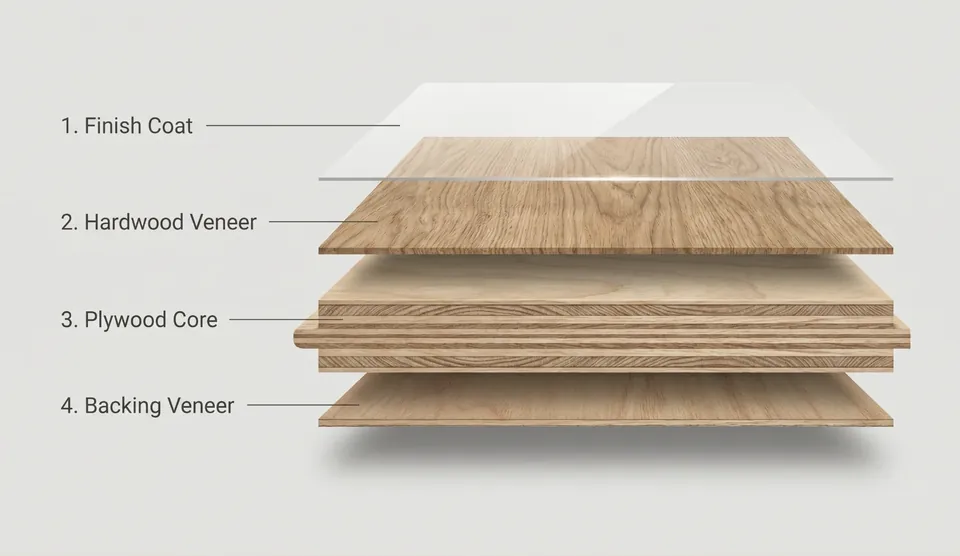
Simplified diagram of engineered hardwood plank construction showing four layers: 1. Finish Coat, 2. Hardwood Veneer, 3. Plywood Core, 4. Backing Veneer
Simplified diagram — an engineered hardwood plank, separated into its four layers. Every board you walk on is these four things bonded together.
1Finish CoatA factory-cured protective coating on the very top. It takes the daily wear instead of the wood, and it is why a spill wiped promptly leaves nothing behind.
2Hardwood VeneerGenuine oak, walnut, hickory, maple or ash — the wood you see and live on. In real life its thickness decides everything: a 3–4 mm veneer can be sanded and refinished years from now; under 1 mm cannot.
3Plywood CoreLayers of wood bonded with the grain of each running across the one beneath, so the board resists seasonal movement. The milled tongue and groove edge you can see here is what locks neighbouring boards into one level floor.
4Backing VeneerA balancing layer underneath. It mirrors the pull of the top layers so the plank stays flat instead of curling — quiet, invisible, and the reason engineered boards behave the way they do.
03 — The Real Comparison

Solid Hardwood vs Engineered Hardwood

Both are real wood with a genuine hardwood surface. They differ in how they are built — and that difference decides plank width, installation options, and where each belongs. We sell both, so here is the straight version.
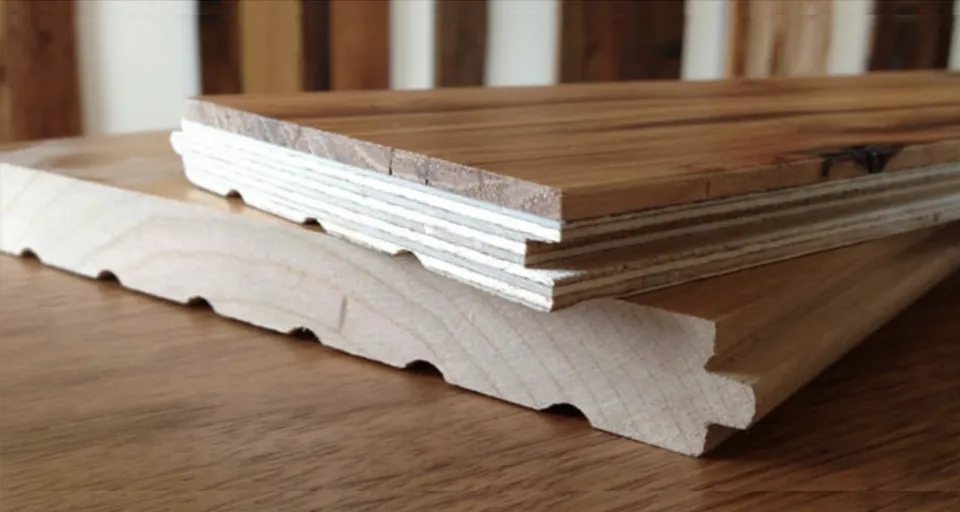
Two flooring planks side by side: an engineered hardwood plank showing its real hardwood veneer over a multi-ply plywood core, and a solid hardwood plank milled from one piece of wood with a tongue and groove edge
The difference you can see in your hand. Behind: an engineered plank — a real hardwood wear layer bonded over a plywood core of thin wood plies. In front: a solid plank, one piece of hardwood from top to bottom. Both are milled with a tongue and groove edge; both give you a genuine wood floor.
Traditional

Solid Hardwood

  • 100% solid hardwood, top to bottom
  • Traditional nail or staple-down installation
  • The refinishing champion — sandable many times over a very long life
  • Widths commonly more limited — often up to about 5″, depending on species and supplier
  • Expands and contracts noticeably with the seasons; wants stable indoor humidity
  • Above-grade, over wood subfloors only
Modern

Engineered Hardwood

  • Real hardwood veneer — the same wood, on top
  • Multi-ply plywood core for excellent dimensional stability
  • Readily available in wide planks — 7″, 8″, even 9″ and beyond — the modern wide-plank look solid struggles to match
  • Glue, nail, glue assist or float — whichever suits your subfloor and the product’s approvals
  • Handles condos, concrete and Ontario’s seasonal swings far better
  • Basement-capable where the product is approved for below grade
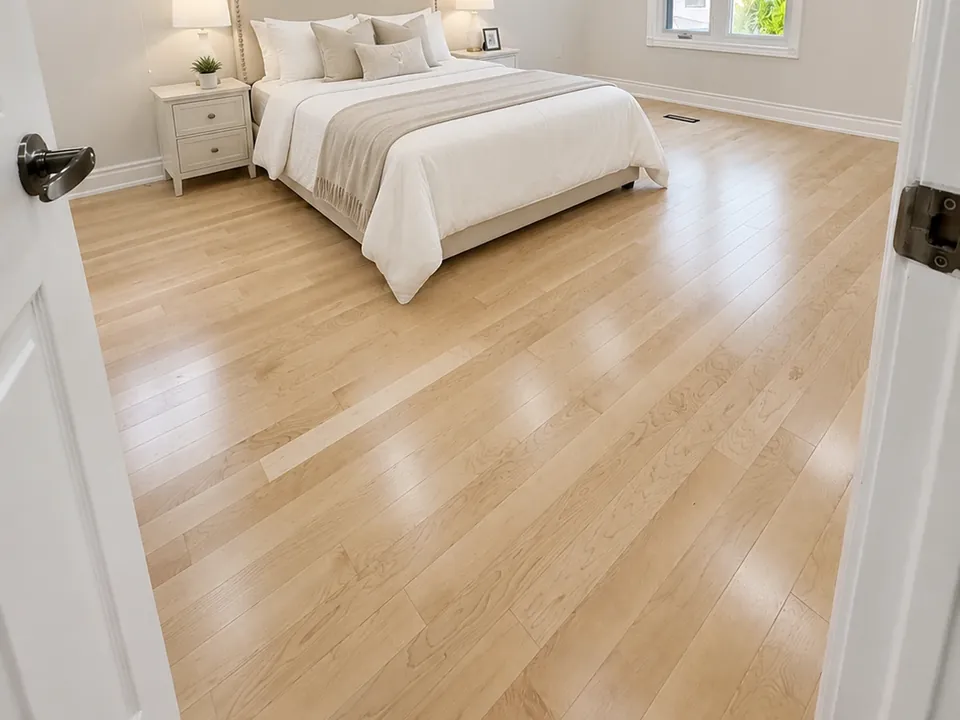
Solid maple hardwood flooring in a bright bedroom, showing the narrower plank widths typical of solid hardwood
Solid HardwoodNarrower boards, one continuous piece of wood — the traditional look, and the longest refinishing life.
Wide plank engineered hardwood flooring in a modern kitchen with dark cabinetry and brass fixtures
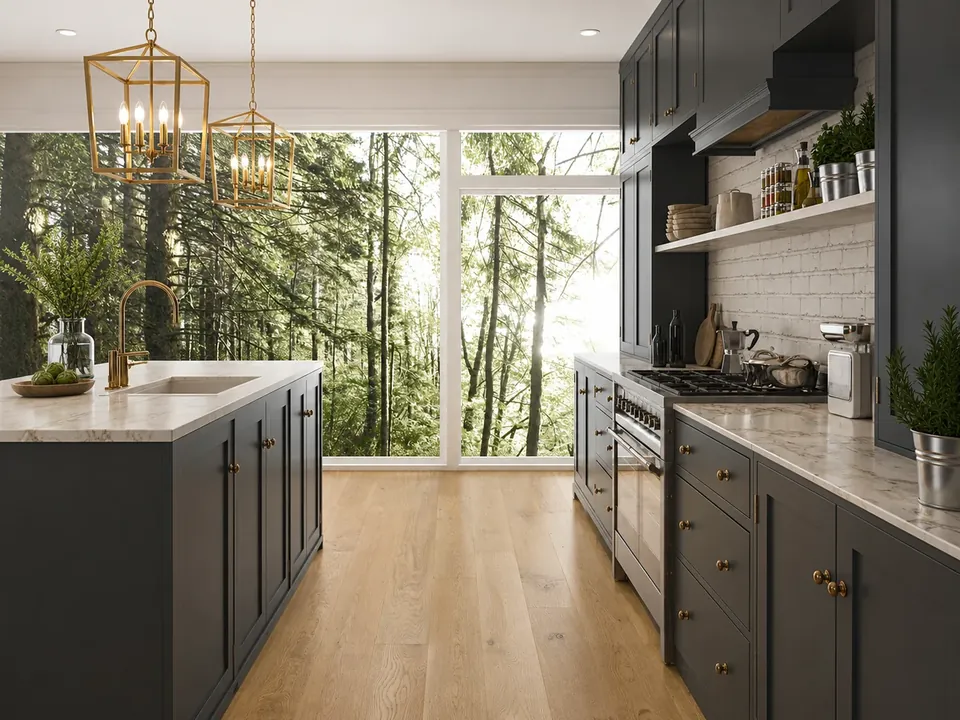
Engineered HardwoodWide planks over a plywood core — the calm, modern look, and the stability that makes it possible.
StabilityResists seasonal movement
MoistureHandles humidity better
Radiant HeatCompatible where approved
InstallationGlue, nail or float
RefinishingWith a thicker veneer
EfficiencyMore floors per tree
04 — Installation Methods

Nail, Glue, Glue Assist or Floating — In Plain Language

The right method is not a preference — it comes from your subfloor, the width of the plank, and what the manufacturer approves. Here is how we decide, explained simply.
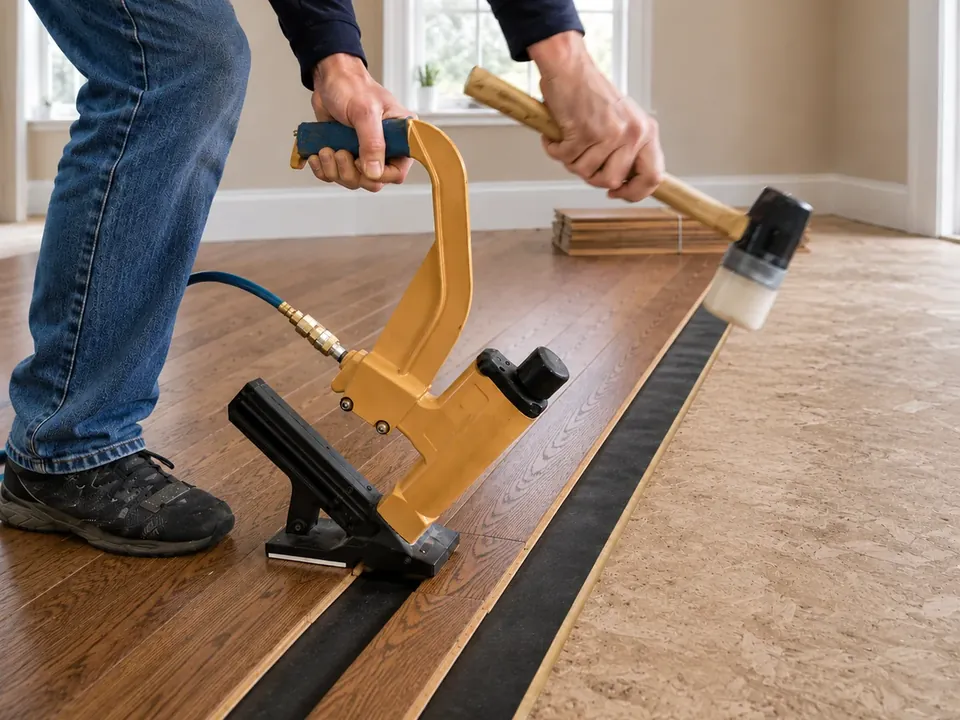
Nail / Staple Down The traditional method over plywood or OSB. Planks 6-1/2″ or narrower can usually perform very well nailed or stapled, when the product and subfloor allow it — fast, secure, and the classic hardwood feel underfoot.
A flooring installer using a pneumatic flooring nailer and mallet to fasten hardwood planks to a plywood subfloor
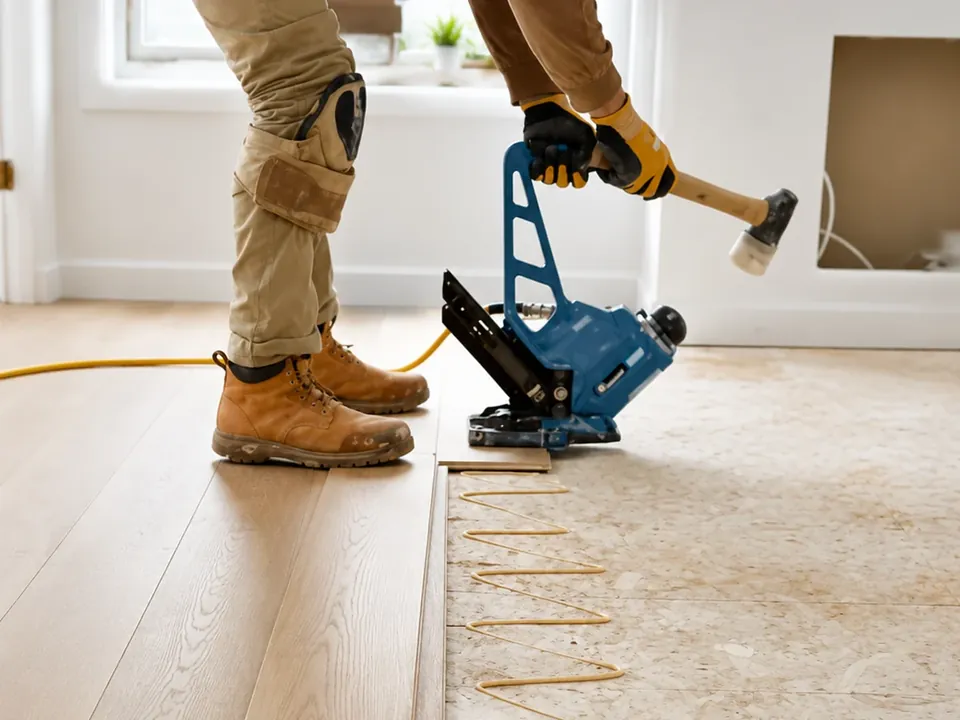
Nail + Glue Assist Nails or staples plus adhesive, working together. Planks wider than 6-1/2″ usually benefit from glue assist, because wider boards carry more wood and need the extra hold to stay flat and quiet through the seasons.
A flooring installer nailing wide plank hardwood over a subfloor with beads of adhesive already applied ahead of the boards
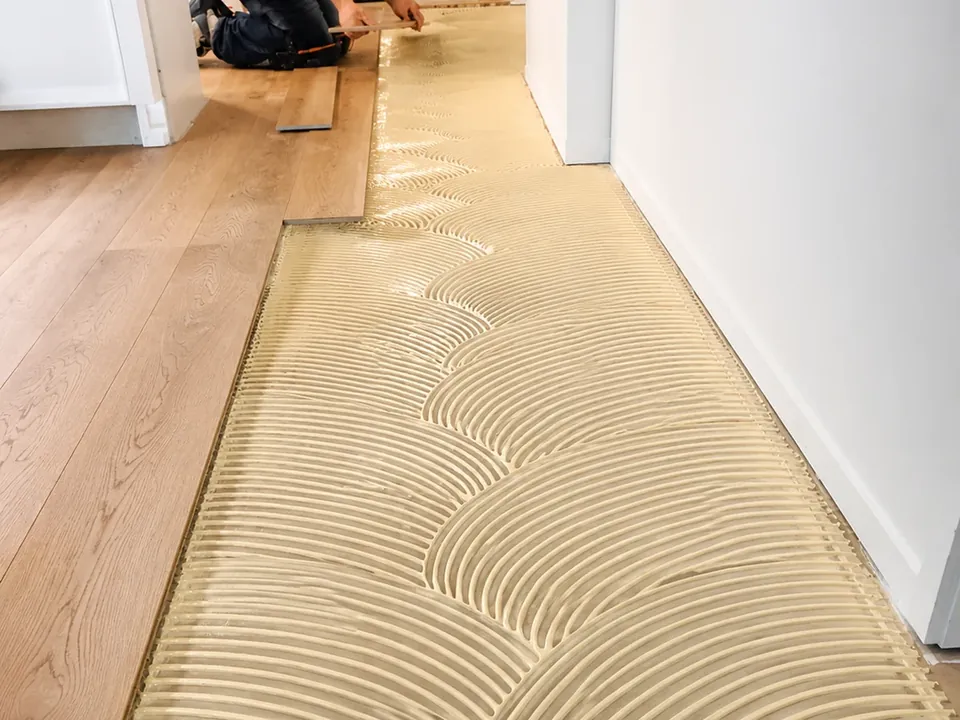
Full-Spread Glue Down Adhesive across the whole subfloor, every board bonded. It can cost more, but it is often considered the most stable and premium installation — the quietest, most solid result, and the standard approach over concrete.
Flooring adhesive trowelled across a subfloor in even ridges before wide plank hardwood is laid into it
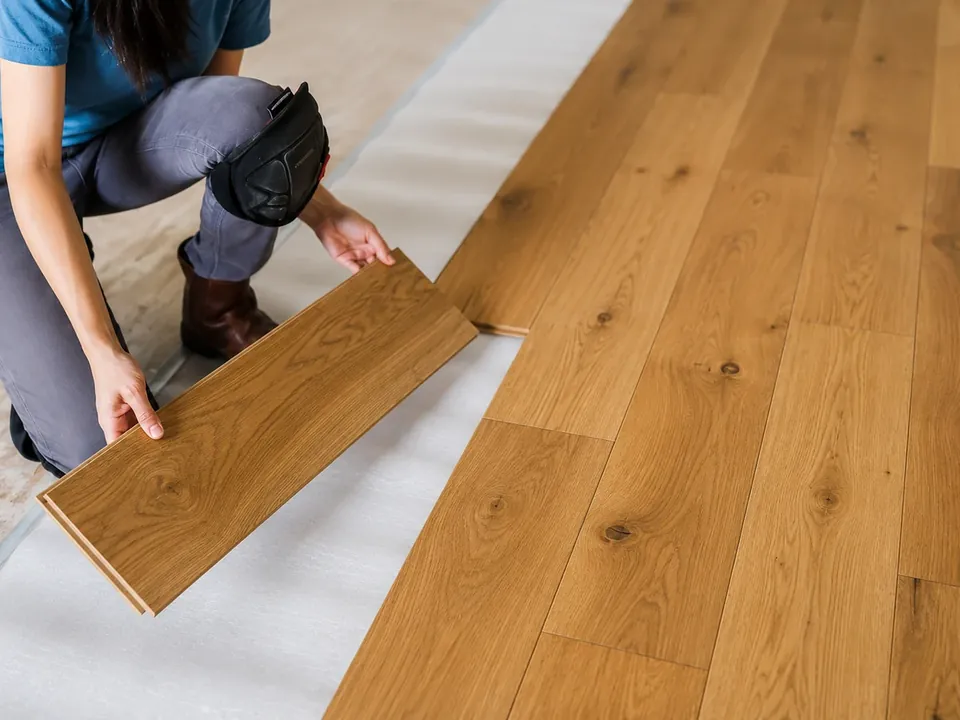
Floating Boards connect to each other over an underlay instead of to the subfloor. Some products allow it, and it is kind to budgets and timelines — but it depends entirely on the manufacturer’s approval and your subfloor.
An installer clicking a hardwood plank into place over an underlay for a floating installation

The honest bottom line: the final installation method must always follow the manufacturer’s instructions and your site conditions. At your free in-home estimate — anywhere from Bolton and Caledon to Brampton, Vaughan and the rest of the GTA — we check the subfloor, the plank width and the product’s approvals, then recommend the method we would use in our own homes.

05 — Subfloors

What It Can Be Installed Over

Engineered hardwood is far less fussy than solid about what sits underneath — which is exactly why it works in condos and modern builds where concrete is the norm.
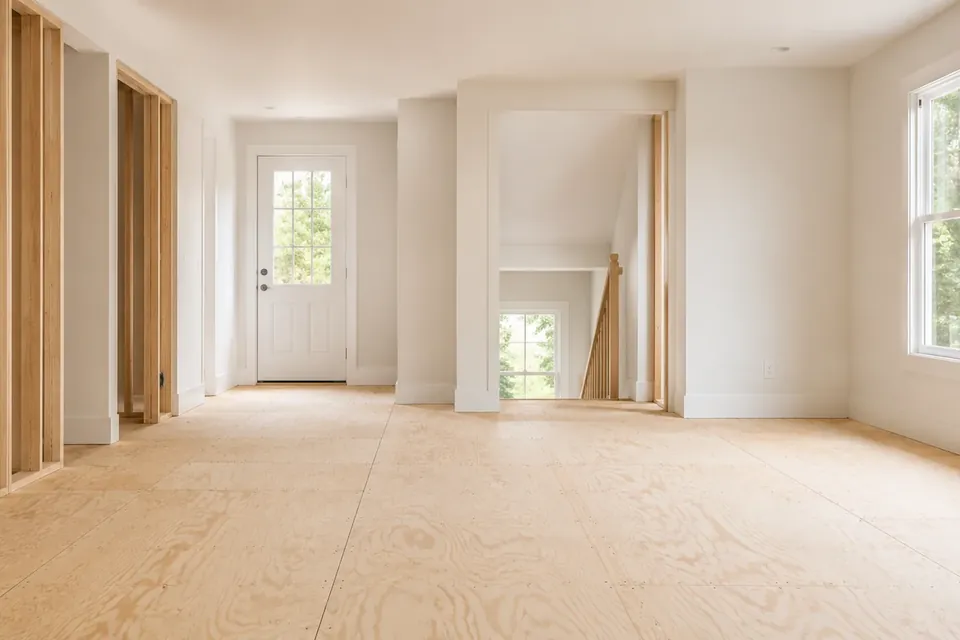
Plywood subfloor laid and ready for engineered hardwood installation in a newly framed room PlywoodThe classic wood subfloor. Takes nail-down, glue-down or floating — all three are on the table.
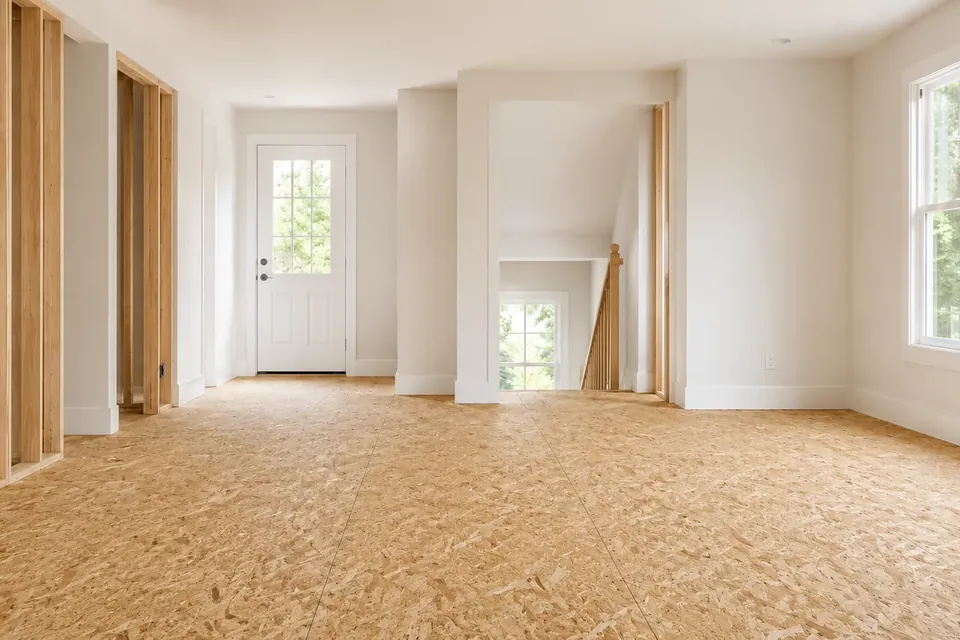
OSB strand board subfloor in a new build, prepared before hardwood flooring is installed OSBCommon in newer builds. Nail-down and floating are typical; glue-down depends on the adhesive and the board.
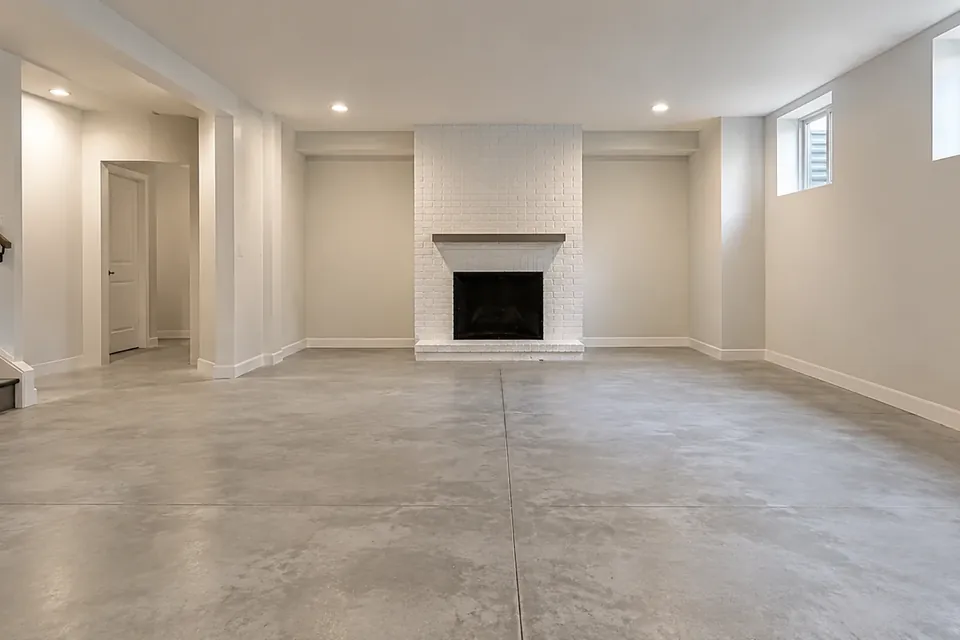
Bare concrete slab in a finished basement, the subfloor engineered hardwood can be glued down to or floated over ConcreteGlue-down or floating, always with a moisture test first. This is where engineered beats solid outright.

Every subfloor must be clean, dry, flat and properly prepared — and moisture-tested where concrete is involved. Preparation is part of every Supply & Install project we quote.

06 — The Whole-House Question

Can Engineered Hardwood Be Installed Throughout the Whole House?

Yes — through most of the home, with a little common sense. One consistent floor flowing across an entire level makes a home feel bigger, cleaner and more elegant, and it is one of the most requested looks in Bolton and Caledon right now. Suitability always comes down to moisture exposure, lifestyle, and the product’s own approvals.

How to make whole-house hardwood work

  • A waterproof mat at the front foyer and entrances — winter boots are the floor’s real enemy
  • A mat in front of the kitchen sink and dishwasher
  • Wipe spills when you see them — the finish gives you time, not permission
  • Felt pads under furniture, and reasonable indoor humidity through winter

Where to draw the line — honestly

  • Full bathrooms are not recommended — standing water and steam win eventually; use waterproof vinyl or tile there
  • Powder rooms can be acceptable with proper care, good ventilation and quick spill cleanup — a judgement call we make honestly with you
  • Basements only where the specific product is approved for below grade and the slab tests dry
Main FloorsLiving, dining and hallways — where real wood does the most for how a home feels and shows.
BasementsWhere the product is approved for below grade and the slab tests dry. If not, we will point you to vinyl.
CondosConcrete floors, tight schedules and building rules — glue-down or floating engineered handles all three.
StairsMatching treads and nosings turn a staircase into the feature of the house — our specialty in Bolton.
07 — Longevity

Can It Be Refinished?

Yes — if the veneer allows it. This one spec decides whether your floor can be renewed in fifteen years or has to be replaced. It is the number we point at first, and the number most stores never mention.
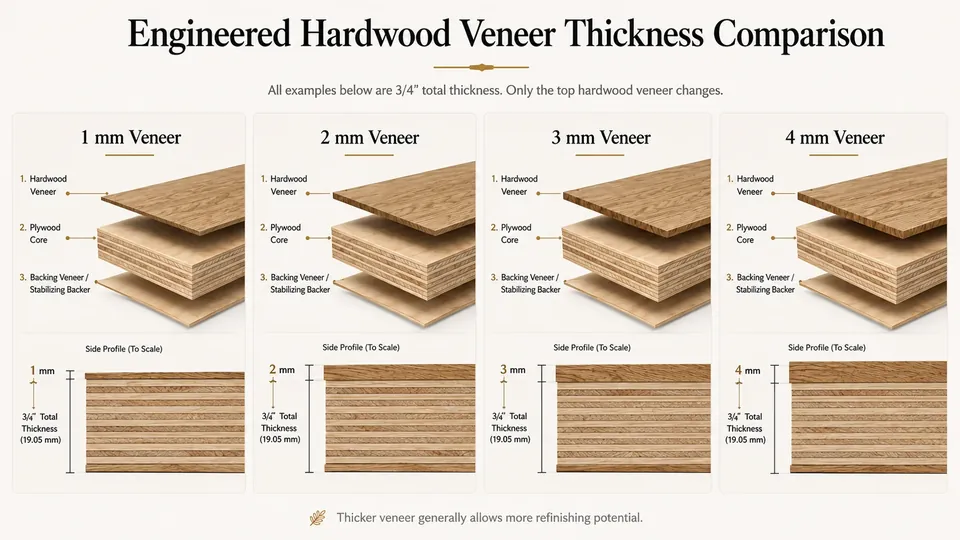
Four engineered hardwood boards of identical 3/4 inch total thickness, shown with 1 mm, 2 mm, 3 mm and 4 mm hardwood veneers over a plywood core and backing veneer, with side profiles drawn to scale
The same 3/4″ board every time — only the hardwood layer on top changes. That top layer is the only part a sander can ever touch, which is why it decides whether a floor can be refinished.
Under 1 mm No refinishing 1–2 mm Light recoat only 2 mm Refinishing begins 3 mm One full refinish 4 mm Multiple refinishes Thinner veneer — lower cost Thicker veneer — longer life The rule we give customers Staying ten years or more, or living with big dogs? Spend on veneer before you spend on plank width.

The veneer is the only part of an engineered board a sander can touch. Once it is gone, it is gone — so this number quietly sets the ceiling on your floor’s lifespan.

A thin-veneer floor can still look magnificent for many years, and for a rental or a shorter stay it is often the smart buy. But if you intend to hand this floor to the next stage of your life, thickness is what buys you that option.

Every product page states its veneer thickness plainly, and you can filter the whole collection by it. Refinishing allowances vary by product — we confirm the manufacturer’s own published figure with you before you buy, and we never claim a refinish the maker has not backed.

08 — Confidence

Warranty & Durability

What stands behind the floor once the last board is down.

Structural WarrantyCovers the board itself. Terms vary by product — we show the manufacturer’s exact wording, never a rounded-up version.
Finish WarrantyA separate term covering surface wear-through. Two different numbers — we list both, because they are not the same promise.
2-Year Limited Workmanship WarrantyOur own limited workmanship warranty on the flooring installation work in your written scope.
Verified SpecificationsEvery figure on our product pages comes from the manufacturer’s own documents. If something is not published, we say so.
Putting It Into Practice

The Four Decisions That Shape Your Floor

Now that you know how the board is built, how it installs and where it belongs, choosing one comes down to four things: the veneer on top, the species of wood, the grade of its appearance, and the size of the plank. Here is each one in plain language.

Decision 01

Veneer Thickness: The Spec That Matters Most

The veneer is the slice of real hardwood on top, and its thickness quietly decides how long your floor can be kept beautiful. A thin veneer still looks identical on day one — the difference appears years later, when a deep scratch or a sun-faded patch makes you wish you could sand and refinish.

VeneerWhat it really means
Under 1 mmBudget-friendly and attractive, but treat the finish as final — there is not enough wood to sand later.
1–2 mmThe sensible middle. Handles a light screen-and-recoat; deep refinishing is generally not realistic.
2 mmThe threshold where refinishing starts to become a real option, product and installer permitting.
3 mmComfortable refinishing territory — typically at least one full sand-and-refinish over the floor’s life.
4 mmNear-solid performance. Multiple refinishes are typically possible — a floor your kids can renew instead of replace.

Our honest rule: if you plan to stay in the home ten years or more, or you have large dogs, prioritize a thicker veneer over an extra foot of plank width. Exact refinishing allowances vary by product, and we confirm the manufacturer’s own figure with you before you buy.

Decision 02

Wood Species: Six Personalities

Hardness figures are approximate industry Janka ratings — a useful comparison, not a durability guarantee. The finish and veneer do much of the real work.

American White Oak

Balanced · ~1360 Janka

The benchmark. Strong, even grain that takes every stain honestly — from pale natural to deep espresso. If you are unsure, start here.

European Oak

Elegant · ~1120 Janka

Longer, calmer grain lines and soft mineral character. The species behind most of the wide-plank, designer looks you have saved to your phone.

Walnut

Luxurious · ~1010 Janka

Naturally deep chocolate tones no stain quite imitates. Softer underfoot — best in bedrooms, dens and lower-traffic rooms that deserve drama.

Hickory

Toughest · ~1820 Janka

The hardest of the group, with bold colour movement from cream to cocoa in a single board. A favourite for busy families and farmhouse looks.

Maple

Clean · ~1450 Janka

Fine, subtle grain and a naturally light, contemporary face. Loves modern and Scandinavian rooms; prefers clear or lightly tinted finishes.

White Ash

Lively · ~1320 Janka

Oak-like strength with a livelier, ribbon-figured grain and a naturally blonde cast. An underrated choice that reads bright and expensive.

Decision 03

Grade: Appearance, Never Quality

Grading sorts boards by how the wood looks — knots, mineral streaks, colour movement. It says nothing about strength or durability: every grade is the same species, milled the same way, and lasts the same length of time. A rustic board is simply a board with more of its life story showing. Many of our favourite floors are the characterful ones, and they are usually friendlier on the budget too.

The industry standard set by the National Wood Flooring Association runs Clear, Select, No. 1 Common and No. 2 Common. Suppliers rarely use those words on a box — you will see Prime, ABC+, ABCD, Natural, Rustic and plenty besides. Four tiers cover what actually matters:

Select & Better

The cleanest face

A combined grade: every board is Select or cleaner, so nothing below Select gets into the bundle. Fewest knots, tightest colour range and the longest average boards — the calmest, most formal floor money buys, and priced accordingly.

Select

Clean · Prime · ABC

Calm and uniform, with the natural colour difference between heartwood and sapwood and only small, occasional character marks. A refined face for formal and minimalist rooms without the Select & Better premium.

Character

Natural · ABCD

Natural knots, mineral streaks and more colour variation — the way most people picture real wood. The most forgiving grade for busy homes.

Rustic

Full Character · Cabin

Heavier knots, filled splits and strong natural character. Deliberate, confident, and stunning in cottages, lofts and heritage renovations.

Decision 04

Width, Pattern & Texture

Width. Narrower boards up to 5″ read classic and make small rooms feel busier with lines; planks of 7″ to 9″ show more of each board’s grain and make open-concept spaces feel calm and expensive. As boards get wider, the stability of the plywood core matters more — one of the quiet reasons wide-plank buyers choose engineered over solid.

Pattern. Straight plank suits almost everything. Herringbone and chevron turn the floor itself into the design feature — they use more material and more installation skill, and they are worth it in entries, dining rooms and principal spaces. We install both.

Texture. Wire-brushed surfaces have the soft fibres brushed out, so the grain you feel is real — and everyday scuffs and pet traffic hide remarkably well. Smooth finishes are sleek and contemporary but show life more readily. Hand-scraped adds gentle, old-world undulation, at home in traditional rooms.

Honest Comparison

Engineered vs Solid vs Laminate vs Vinyl

We sell all four — so we have no reason to oversell any of them. This is the same comparison we draw on paper in the showroom.

 Engineered HardwoodSolid HardwoodLaminateVinyl / SPC
Surface✓ Real wood✓ Real woodPrinted imagePrinted image
Seasonal stability✓ Very goodFair — moves with humidity✓ Good✓ Excellent
Water resistanceSurface spills onlyLowVaries by product✓ 100% waterproof options
BasementsOnly if product-approved✗ NoVaries✓ Yes
Refinishing✓ With 2 mm+ veneer✓ Multiple times✗ Never✗ Never
Installation methods✓ Nail, glue, float & glue-assistNail/staple down onlyFloating click onlyClick, glue-down or loose lay
Feel & sound✓ Warm, solid, quiet✓ The benchmarkHarder, can sound hollowQuiet, slightly softer
Resale impression✓ “Real hardwood”✓ “Real hardwood”“Laminate”“Vinyl”
Typical price feelMid to premiumPremiumBudget to midBudget to mid

Shortcut: want real wood with fewer seasonal moods — engineered. Want a century floor and don’t mind the maintenance — solid. Need waterproof or basement-proof — vinyl. Stretching a budget across a big area — laminate.

FAQ

Questions We Answer Every Day

Straight answers, the same ones you would get across our counter. Still unsure? Visit the Bolton showroom or call 905-872-7557 — no pressure, ever.

Yes — completely. The surface is a veneer of genuine hardwood, cut from the same oak, walnut or hickory as solid boards. Underneath, a plywood core of thin wood plies replaces a single plank of lumber, which is why it stays flatter through Ontario’s humidity swings. Once installed, guests cannot tell engineered from solid by looking or walking on it.
Solid is a lifetime floor that can be refinished many times, but it demands stable humidity and a nail-down installation over a wood subfloor. Engineered gives you the identical real-wood surface with far better seasonal stability, more installation options, and wide-plank looks that solid struggles to match. For most modern GTA homes — especially with concrete, open-concept layouts or wide planks — engineered is the smarter buy. We sell both and will tell you honestly which suits your house.
They answer different questions. Laminate is a printed image on a dense fibreboard core — excellent value and scratch resistance, but it is not wood and can never be refinished. Engineered hardwood is real wood: it feels warmer, sounds more solid, adds more resale value, and with a 2 mm+ veneer it can be renewed instead of replaced. If budget is the deciding factor, laminate is a respectable choice — we sell a lot of it. If you want the floor buyers call “hardwood,” choose engineered.
Vinyl wins on water: it is 100% waterproof, which real wood will never be, so bathrooms, laundry rooms and most basements belong to vinyl. Hardwood wins on everything wood is loved for — genuine grain, warmth underfoot, prestige at resale, and a surface that can be refinished rather than replaced. Many of our customers use both: hardwood on the main living levels, vinyl below grade and in wet rooms.
Only if the specific product is approved for below-grade use — many engineered floors are not, and moisture from a concrete slab is unforgiving. Where a manufacturer does approve it, strict moisture testing and the right underlay are non-negotiable, and we verify all of it before you spend a dollar. Honestly? For most basements we recommend our waterproof vinyl instead, and save the hardwood budget for the floors above.
An everyday spill — a knocked-over glass, a dripping dog bowl, wet boots — is no drama: the factory finish keeps liquid sitting on the surface long enough for you to wipe it up, and that is the honest extent of it. Real wood is water-resistant on top, never waterproof through and through. Standing water that sits for hours, leaking appliances, or chronic damp will eventually mark or swell any hardwood, engineered or solid. Our plain rule: wipe spills when you see them, keep hardwood out of full bathrooms and laundry rooms, and if a space is likely to get properly wet, put waterproof vinyl there instead — we will tell you which is which room by room.
Select & Better is a combined grade — the lowest board allowed into the bundle is Select, so everything in the box is Select or cleaner. In practice that means the fewest knots, the tightest colour range and the longest average board lengths available, which is why it costs more than a straight Select run. It is the grade to ask for when you want a calm, formal, almost gallery-quiet floor. Remember that grade only ever describes appearance: a Select & Better board is no stronger and no longer-lasting than a rustic one from the same species.
Yes — and one continuous floor across a level is one of the most elegant things you can do to a home; it reads bigger, calmer and more expensive. The practical recipe: a waterproof mat at the foyer, a mat at the kitchen sink, spills wiped promptly, and a firm line at full bathrooms — those belong to waterproof vinyl or tile. Powder rooms can work with good ventilation and quick cleanup. We plan the whole-house layout, transitions and stairs at your free in-home estimate.
Yes — kitchens are one of the most popular places for it, and hardwood flowing through an open-concept kitchen is a look buyers pay for. It just asks for a little respect: a mat in front of the sink and dishwasher, spills wiped as they happen, felt pads under stools and chairs. A wire-brushed texture and character grade also help everyday kitchen life disappear into the grain. If your household is harder on floors than that — or a fridge line has leaked on you before — a wood-look waterproof vinyl in the kitchen with hardwood elsewhere is a combination we install all the time.
Under 1 mm: beautiful but final — no refinishing, so it suits shorter horizons and tighter budgets. 1–2 mm: the sensible middle; a light screen-and-recoat is realistic. 2 mm is where true refinishing starts to open up, and 3–4 mm veneers behave almost like solid wood, typically allowing one or more full refinishes. Staying ten-plus years, or have big dogs? Put your money in veneer before width. We confirm each product’s published refinishing allowance with you before purchase.
Grade describes appearance only, never strength. Clean grade has fewer knots and calmer, more uniform colour. Character grade shows natural knots, mineral streaks and more variation — how most people picture real wood. Rustic grade turns that character up: heavier knots, filled splits, bold movement. It is the same wood at the same durability — simply a different personality, and often a friendlier price.
There is no single best — there is a best fit. American white oak is the do-everything benchmark; European oak gives the long, calm designer grain; hickory is the hardest and most forgiving with kids and dogs; maple reads clean and contemporary; white ash is bright and lively; walnut is the luxury tone, best kept to gentler rooms. Undecided? White oak is never the wrong answer.
A wire-brushed board has had its softest surface fibres brushed away, leaving the harder grain standing in gentle relief you can feel. Practically, that texture is camouflage: everyday scuffs, grit and pet traffic disappear into it instead of showing up as marks on a mirror-smooth face. It is our most recommended texture for busy family homes.
Overall board thickness (12–19 mm) affects stiffness, feel underfoot, and how the floor meets adjacent surfaces — a 19 mm (3/4″) board feels most like traditional solid. But thickness is less important than what is on top: a thick board with a paper-thin veneer is still a floor you can never refinish. Choose veneer first, thickness second; we will confirm transitions and door clearances at your estimate.
Yes — if the veneer allows it. Roughly 2 mm is where refinishing becomes realistic; 3–4 mm veneers typically take one or more full sand-and-refinish cycles. Below 1 mm, plan to love the factory finish for the floor’s whole life. Every product page here states the veneer thickness plainly, and we never claim refinishing a manufacturer has not backed.
Over a plywood subfloor, nail or staple down is the classic, rock-solid choice. Over concrete, glue down gives the quietest, most connected feel. Floating installs fastest and is kindest to budgets. Wide planks are sometimes nailed with glue assist for extra insurance. The real answer comes from your subfloor and the product’s approved methods — both of which we check at your free in-home estimate rather than guessing.
Real wood scratches — anyone who says otherwise is selling something. That said, the right choices make a family-proof hardwood: hickory or white oak for hardness, wire-brushed texture and character grade to hide life’s evidence, and a thicker veneer so a decade of wear can eventually be sanded away. Felt pads, door mats and trimmed claws do the rest. Want zero-worry floors with dogs that drool lakes? That is a fair case for vinyl — we will say so.
Less is more. Sweep or vacuum on hard-floor mode, wipe spills promptly, and clean with a barely damp mop and a hardwood-specific cleaner — never steam, never soaking water, never vinegar or oil soaps. Felt pads under furniture, mats at entries, and reasonable indoor humidity (roughly 35–55%) through winter. That routine keeps a quality floor beautiful for decades.
Order about 10% over your measured area for straight plank installations, and 15% for herringbone, chevron, diagonals or rooms with many cuts. The overage covers cutting waste, the occasional board you edit out, and — smartly — leaves a box in your basement for future repairs from the same production batch. We calculate exact box counts at your free estimate.
If you value real wood, yes — and measurably. Hardwood consistently ranks among the finishes buyers and appraisers reward; listings say “hardwood throughout” for a reason, and no one writes that about a printed floor. Choose a sensible veneer and a durable species and you are not buying a surface, you are buying decades of floor with a renewal option built in. Where hardwood is not the right value — wet rooms, most basements, hard-use rentals — we will steer you to vinyl or laminate ourselves.
Please do — wood is a material you should judge in person and in your own light. Our Bolton showroom at 55 Healey Rd, Unit 2 keeps full-size boards on the floor, and samples are available to take home. Bring your cabinet door or paint chip; we enjoy that part.
Local Expertise

Engineered Hardwood for Bolton, Caledon & the GTA

Our showroom sits in Bolton, and most of the floors we install go into homes within a half-hour of it — Caledon, Brampton, Vaughan, Woodbridge, Kleinburg, King City and Maple, out to Mississauga, Etobicoke and Toronto, and north through Orangeville, Alliston, Tottenham and New Tecumseth. That matters more than it sounds: we know what furnace-dry January does to wood floors in this region, which is exactly why we talk so much about veneers, humidity and acclimatization before a single box is ordered.

Supply and installation are one team here — the people who help you choose the floor are connected to the people who install it, and the flooring installation is covered by our 2-year limited workmanship warranty. Planning stairs to match? Hardwood flooring and staircase renovation together is our specialty. Prefer to start smaller: laminate and waterproof vinyl live in the same showroom, with the same honest advice.

The Flooring Mart · Bolton, Ontario

Choose it with your own hands.

Full-size boards on the floor, honest answers across the counter, and a free in-home estimate when you’re ready. That’s how flooring should be bought.